
THE UNTOLD JOURNEY: A CRITICAL READING OF GUTAM SWAMY’s YASODHARA
Article written by: M. Koteswar Rao
******
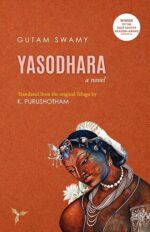
The story of the Buddha is among the most familiar spiritual narratives in Asia. Siddhartha’s departure from the palace, his search for an answer to human suffering, his enlightenment and his emergence as the Buddha have been narrated for centuries. Yet the traditional story has largely been organised around the man who leaves. The emotional and social consequences of that departure, particularly for the woman who remains behind, have received far less narrative attention. Gutam Swamy’s Yasodhara, translated into English by K. Purushotham and published by Hawakal, enters precisely this neglected space. The novel does not merely insert Yasodhara into the Buddha’s story; its more significant intervention is to change the centre of attention. The question is no longer only why Siddhartha left, but what his leaving meant to those whose lives continued after him.
This change of perspective is the novel’s principal literary strength. Siddhartha’s renunciation is ordinarily celebrated as an extraordinary act of spiritual courage. From Yasodhara’s perspective, however, the same event acquires an ethical and emotional complexity that cannot be ignored. A man’s search for liberation may be spiritually exalted, but it also has consequences for a wife, a child and a family. By bringing these consequences into view, Swamy makes the familiar story less one-dimensional. Renunciation becomes not simply a heroic departure but also an event that has to be understood from the perspective of those who experience abandonment, uncertainty and responsibility.
Yasodhara enters the novel as a princess of the Koliya clan who becomes part of the Sakya royal household through her marriage to Siddhartha. The world in which she lives is shaped by royal privilege, clan relationships, political expectations, ritual practices and social obligations. The novel’s recreation of this world is important because Yasodhara cannot be separated from the historical and cultural environment that defines her choices. At the same time, the emotional world created by the narrative remains accessible to the modern reader. Love, jealousy, insecurity, motherhood, loneliness, loss and the desire for meaning are not confined to one historical period. The novel therefore works through a productive tension between cultural distance and emotional familiarity.
The early relationship between Yasodhara and Siddhartha is particularly important because it prevents the later separation from becoming an abstract conflict between worldly life and spiritual life. They are presented as a couple who share affection and companionship. Their relationship contains the possibility of an ordinary domestic future. Siddhartha’s growing dissatisfaction with palace life therefore becomes more consequential. His awareness of impermanence, suffering, ageing and death gradually places him at a distance from the life that Yasodhara continues to inhabit. The novel’s emotional force comes partly from this widening gap: two people can share love and yet move towards fundamentally different understandings of what life requires.
The central critical question raised by the novel is not simply whether Siddhartha was right or wrong to renounce the world. Such a judgement would reduce a complex literary problem to a moral verdict. The more productive question is what happens when two legitimate human aspirations come into conflict. Siddhartha seeks a truth that he believes transcends family and social obligations. Yasodhara must live within those obligations. His problem is how to overcome attachment; hers is how to live with attachment after the person to whom she is attached has chosen to leave. The contrast creates two distinct models of confronting suffering.
Yasodhara is most convincing when she is allowed to be emotionally complex. She is not a permanently serene figure who accepts everything without resistance. Her jealousy, anxiety and insecurity make her recognisably human. Her encounter with Siddhartha among courtesans reveals the vulnerability of a woman who loves and therefore has something to lose. This is important because idealised portrayals of women in religious narratives can turn them into symbols rather than characters. Swamy’s Yasodhara has emotions that complicate the image of the patient and self-sacrificing princess. Her strength emerges not from the absence of emotional disturbance but from her ability to live through it.
Motherhood deepens this conflict. The birth of Rahul carries both personal and dynastic significance. Within the royal household, the child can be understood as a bond capable of strengthening the family and perhaps drawing Siddhartha back towards domestic life. But Siddhartha’s concerns have moved beyond the immediate structures of family and inheritance. Rahul therefore becomes more than a child in the plot. He represents the point at which spiritual aspiration and familial responsibility become impossible to separate. For Yasodhara, motherhood becomes a continuing responsibility rather than a symbolic episode. She has to construct a life for herself and her child in the absence of the man with whom she had imagined sharing that life.
Here the novel makes an important distinction between suffering and the response to suffering. Siddhartha responds by leaving the structures of ordinary life in order to seek liberation. Yasodhara responds by remaining within those structures and learning to live with their burdens. Neither response can be dismissed easily. Leaving may require courage, but remaining can also demand courage of a different kind. The novel’s most interesting contribution is that it asks the reader to recognise this quieter form of courage, which is less celebrated because it does not produce a spectacular historical event.
This also changes the meaning of renunciation. If renunciation is understood only as the abandonment of possessions, privilege and family, then Siddhartha remains the obvious centre of the story. If it is understood more broadly as a struggle with attachment, desire, loss and the search for inner freedom, Yasodhara’s experience becomes equally significant. She cannot simply walk away from responsibility. Her transformation must occur while she remains a mother, wife, daughter-in-law and member of a royal family. Her spiritual movement is therefore shaped by circumstances very different from Siddhartha’s. The novel’s parallel structure is built on this difference.
The novel should not, however, be read as an attempt to diminish the Buddha in order to elevate Yasodhara. Its stronger achievement lies elsewhere. It allows two journeys to exist simultaneously. Siddhartha’s journey is outward: away from the palace and towards the unknown. Yasodhara’s is largely inward: through separation, emotional conflict, motherhood, endurance and self-discovery. His historical transformation is public and monumental. Hers is private and gradual. The asymmetry itself is significant because it reflects the way history traditionally values public acts over private labour.
This question of historical visibility gives Yasodhara a contemporary relevance. Many celebrated narratives are organised around individuals who leave, conquer, discover or transform. The people who remain behind often become background figures. Yet social life is sustained precisely through such forms of remaining. Families continue, children are raised, relationships are renegotiated and emotional wounds are absorbed. Swamy’s novel challenges the hierarchy that places the celebrated departure at the centre and treats the continuing life as secondary. Yasodhara’s story demonstrates that what appears to be a consequence of history can itself become the subject of history.
At the same time, the novel raises a difficult question about gender. Siddhartha’s withdrawal from domestic responsibility is remembered primarily as spiritual courage. A woman who left a husband and child for an individual quest would historically have been judged by very different standards. The contrast exposes unequal moral expectations placed upon men and women. The novel does not need to become an explicit modern feminist argument for this tension to be visible. Yasodhara’s position forces the reader to ask whether spiritual freedom can be evaluated independently of the responsibilities that one leaves to others.
Yasodhara’s endurance should therefore not be interpreted simply as passive sacrifice. The more compelling reading sees endurance becoming a form of agency. She cannot control Siddhartha’s decision, but she can determine how she lives with its consequences. Agency here does not necessarily mean rebellion. It can also mean the gradual recovery of selfhood within circumstances that were not freely chosen. The novel’s portrayal of Yasodhara becomes strongest when her dignity is understood not as silent submission but as an active process of self-definition.
The novel also enters into dialogue with the wider Indian literary imagination of women who bear the consequences of decisions made within larger moral, political or familial structures. Comparisons with figures such as Sita and Gandhari are useful not because Yasodhara is identical to them, but because they reveal a recurring pattern. Women are often positioned at the intersection of personal desire and collective duty. Their suffering becomes meaningful within epic or religious narratives, yet their individual voices can remain muted. Yasodhara’s literary reappearance can therefore be understood as part of a broader effort to recover women from the margins of inherited narratives.
There is, however, a critical tension in such recovery projects. Giving a neglected woman a voice does not automatically free her from traditional ideals of womanhood. If endurance, motherhood, sacrifice and patience remain the principal measures of her worth, the revised narrative may reproduce the very structures it seeks to question. Yasodhara is most significant when her emotional and spiritual value exceeds these prescribed roles. The reader should therefore attend not only to what she suffers but also to how she thinks, chooses, interprets and constructs meaning. A woman should not become important merely because she suffers well.
The literary style of Yasodhara is another aspect that deserves attention. The novel belongs to a narrative tradition that permits considerable description, emotional elaboration and cultural detail. Its presentation of royal life, rituals, nature and relationships is closer in spirit to an expansive historical or epic mode than to the compressed realism of much contemporary fiction. This may make the narrative more elaborate than a modern minimalist reader expects, but it is also part of the novel’s aesthetic identity. Its descriptive richness contributes to the reconstruction of a cultural world and should therefore be read as a feature of its narrative method.
The English translation by K. Purushotham assumes particular significance in this context. Translation is not merely a linguistic exercise. It determines how a regional literary work enters a larger literary conversation. To carry Yasodhara from Telugu into English is to make its cultural imagination available to readers beyond the original linguistic community. The translator has to negotiate names, cultural references, emotional registers and a narrative style shaped by another literary tradition. The value of the translation therefore lies in its capacity to preserve the cultural specificity of the work while making its central emotional and philosophical questions intelligible to a wider readership.
The translation also places the novel within the growing field of Indian writing in translation, where regional narratives increasingly challenge the idea that Indian literary culture can be represented adequately through a small number of canonical languages and texts. A story such as Yasodhara gains a different significance when it travels from Telugu into English. It becomes part of a wider conversation about regional literature, cultural memory, gender, translation and the reinterpretation of inherited stories.
One of the novel’s larger achievements, therefore, is its questioning of narrative ownership. Who has the right to occupy the centre of a story? Who decides which life becomes historically significant? Why should Siddhartha’s transformation necessarily make Yasodhara’s experience secondary? These questions are literary, but they are also cultural and ethical. Narratives do not simply preserve the past; they determine which lives remain visible within our understanding of the past. By shifting attention to Yasodhara, Swamy changes not only the protagonist but also the moral geography of the familiar story.
The novel’s deepest insight may be found in its treatment of parallel journeys. Siddhartha and Yasodhara do not travel in the same direction, and they do not seek fulfilment in the same way. He seeks liberation by moving away from the attachments of palace life. She has to discover a form of inner freedom while remaining connected to the relationships and responsibilities from which he has withdrawn. His journey is associated with renunciation; hers with endurance and self-discovery. The contrast does not make one journey superior to the other. Instead, it expands the reader’s understanding of what a spiritual journey might look like.
This is also why Yasodhara should not be reduced to the role suggested by the phrase “the woman who remained behind.” The phrase initially describes her historical position, but the novel gradually challenges its implication of passivity. She remains physically within the world from which Siddhartha departs, but she does not remain psychologically or spiritually static. Her life continues to develop. Her relationship with loss changes. Her responsibilities acquire new meaning. Her identity becomes less dependent on the absent husband. Remaining, in this sense, becomes a process of movement rather than immobility.
For a contemporary reader, this reversal of perspective is perhaps the novel’s most valuable contribution. We are accustomed to celebrating the person who takes the extraordinary path. We are less attentive to those who absorb the consequences of extraordinary decisions. Yasodhara asks us to look at the human cost of heroic narratives without necessarily denying their heroism. Siddhartha’s search for truth can remain profound, while Yasodhara’s experience can also be recognised as profound. The two truths do not have to cancel each other.
Ultimately, Gutam Swamy’s Yasodhara is significant because it takes a familiar story and changes the question through which we approach it. Instead of asking only why Siddhartha left, it asks what remained after he left. Instead of treating Yasodhara as a figure waiting for the Buddha, it presents her as a person negotiating love, jealousy, motherhood, loss, responsibility and the search for selfhood. K. Purushotham’s English translation extends this reinterpretation to a wider readership and places the novel within broader discussions of Indian literature and translation.
The lasting value of Yasodhara lies in its insistence that great historical and spiritual transformations are rarely experienced by one person alone. Behind the celebrated departure are lives that must continue. Behind renunciation are relationships that have to endure its consequences. Behind a public transformation may be a private history that remains largely unrecorded. Yasodhara gives that private history literary space. It does not ask us to replace the Buddha with Yasodhara. It asks us to see the story more completely by refusing to leave her at its margins.
Siddhartha leaves the palace and becomes the Buddha. Yasodhara remains—and begins another journey. That journey is quieter, but quietness should not be confused with insignificance. Her journey through love, loss, motherhood, responsibility, endurance and self-discovery enlarges the moral and emotional field of an ancient narrative. The woman who remained behind was never merely behind him. She was living another story, and Gutam Swamy’s novel gives that story the space to be heard.
* M. Koteswar Rao is a Professor of English, Krishna University, Machilipatnam (AP)

Leave a Reply